
Style6 min readby NailRush Live Team2 views
The 'Vascular-Mapping' Technique: Precision Color Selection for Undertone Harmony
Move beyond basic color charts by learning how to analyze subcutaneous blood flow patterns to select the most flattering manicure hues for any client skin tone.
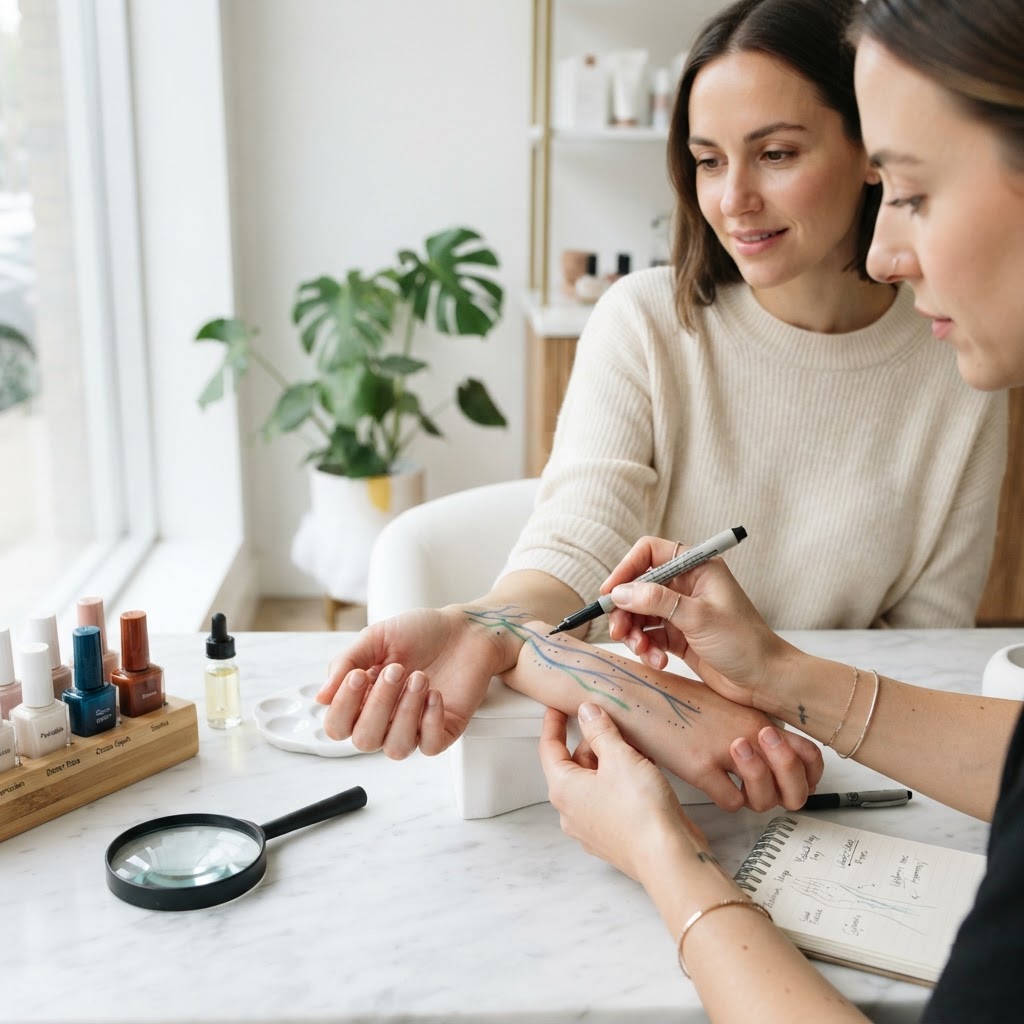
The Science of Subcutaneous Color Matching. Most nail artists rely on surface-level skin tone charts that categorize clients into 'warm' or 'cool.' However, this often results in a manicure that looks discordant upon closer inspection. The 'Vascular-Mapping' technique shifts the focus from the epidermal surface to the subcutaneous layer, where underlying blood flow and vein color provide a more accurate blueprint for pigment selection. ## Identifying Your Baseline. Before selecting a polish, perform a vascular assessment under daylight-balanced lighting. Examine the client's inner wrist, where the skin is thinnest. If veins appear distinctively blue or purple, the client has cool-toned undertones with high melanin suppression. If they appear green or olive, the undertones are warm with a high concentration of yellow carotene. If the veins appear as a mix of both or are difficult to distinguish from the skin tone, the client sits in the neutral zone, which is the most versatile for artistic expression. ## The 'Chromatic-Intensity' Scale. Once the baseline is established, use the following rules to dictate the saturation and opacity of your gel selection: ### Cool Undertones (The Blue-Violet Spectrum) Focus on blue-based reds, crisp whites, and silver-toned glitters. These colors amplify the natural clarity of the skin, preventing a 'muddy' look. Avoid muddy oranges or mustard yellows, as these will draw out dullness in the skin. ### Warm Undertones (The Yellow-Orange Spectrum) Lean into terracotta, ochre, warm gold, and rich coral. These shades complement the yellow undertones, creating a cohesive visual flow. Stay away from icy blues or stark, chalky whites, which can make the skin appear dehydrated or sallow. ## Calibrating for Seasonal Shifts. Skin undertones often appear slightly different between seasons due to changes in sun exposure and circulation. In colder months, superficial blood vessels constrict, often making the skin appear 'cooler' or more pale. In warmer months, blood flow increases, bringing warmer tones to the surface. Always re-evaluate your client's vascular baseline every three months. ## Practical Application: The 'Neutral-Anchor' Test. When you are uncertain about a bold color choice, use the 'Neutral-Anchor' method. Apply three narrow stripes of potential color onto the client's nail plate—avoiding the cuticle zone—to see how they interact with the skin at the proximal fold. 1. Identify the 'Anchor': Select a nude that perfectly matches the client's skin tone. 2. Compare the Shift: Hold your target bold color next to the anchor. If the bold color makes the anchor look 'dirty' or 'gray,' it is likely clashing with the underlying undertones. 3. Adjusting Opacity: If the color feels too jarring, consider a sheer or 'jelly' finish. By allowing the natural nail bed to show through, you bridge the gap between the skin tone and the nail polish, effectively creating a custom-filtered look that flatters the wearer regardless of the specific pigment saturation. By mastering the vascular map, you provide a professional, bespoke service that proves you are not just painting nails—you are engineering a color-theory masterpiece tailored to the individual.
Join the newsletter
Get fresh nail tutorials, trends, and business tips straight to your inbox.
Join the newsletter
Get fresh nail tutorials, trends, and business tips straight to your inbox.
