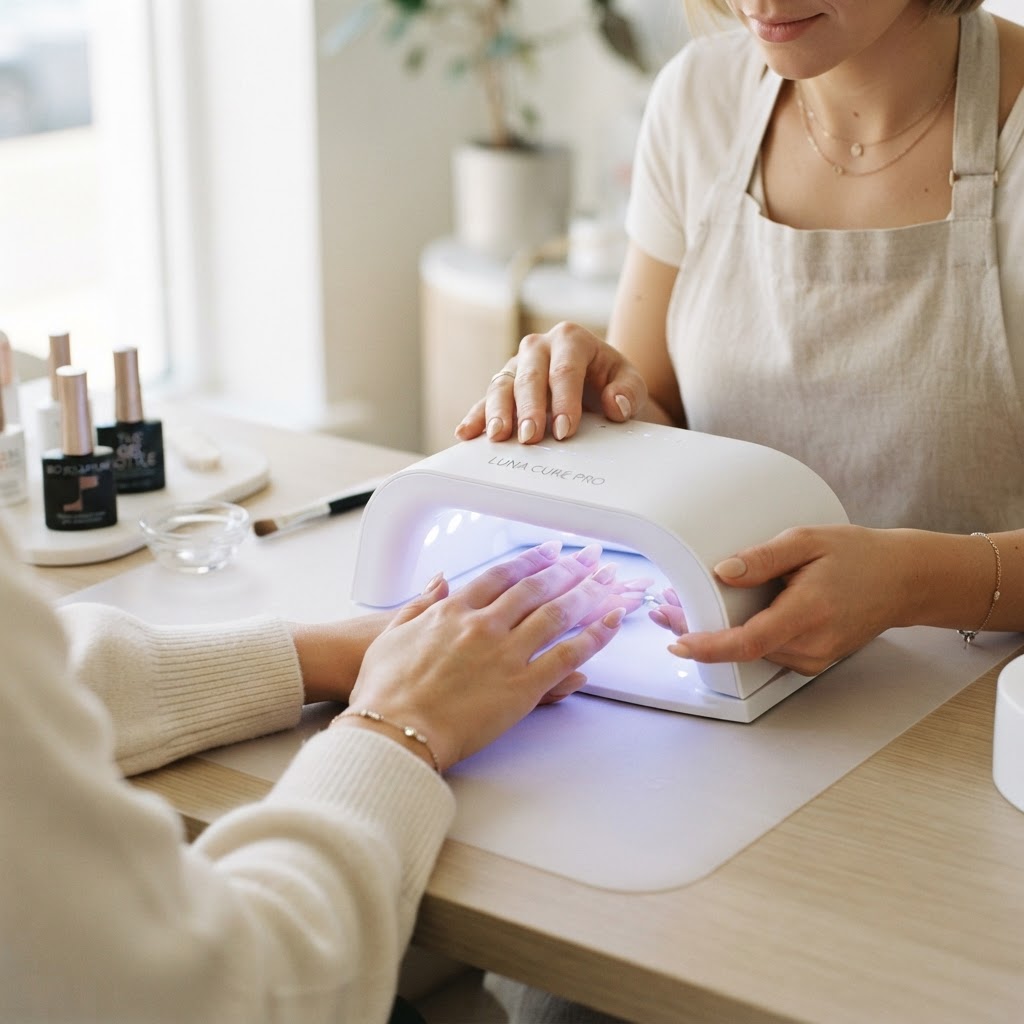
The 'Thermal-Gradient' Modulation: Optimizing Curing Kinetics for Heat-Spike Prevention
Master the physical dynamics of polymerization to eliminate exothermic discomfort in clients while ensuring maximum cross-linking density in high-viscosity builder gels.
The Exothermic Challenge in High-Volume Sculpting
For the professional nail technician, the heat spike—that sharp, burning sensation during gel curing—is more than a minor annoyance; it is a point of significant client friction that can lead to involuntary hand jerking, resulting in misaligned structures or accidental contact with the lamp walls. This thermal surge is a direct result of rapid polymerization, where the exothermic reaction of photo-initiators generates heat faster than it can dissipate into the environment.
Understanding the Polymerization Kinetics
When a photo-initiator absorbs UV or LED light, it initiates a chain reaction. In high-viscosity or highly pigmented products, this reaction happens at an accelerated rate. The 'Thermal-Gradient' Modulation technique shifts the focus from 'curing speed' to 'reaction control.' By manipulating the volume and density of the gel applied in the initial structural pass, we can dictate the thermal output.
The Three-Phase Application Protocol
The Sub-Threshold Base: Apply a thin, un-cured scrub layer of base gel to the nail plate. This acts as a thermal buffer between the nail bed and the bulk material. Cure this layer fully before moving to the structural application.
Join the newsletter
Get fresh nail tutorials, trends, and business tips straight to your inbox.
The 30% Volumetric Shift: Instead of applying your apex-building bead in one singular high-density drop, split your application. Apply 30% of your total product volume as a thin 'scaffolding' layer across the stress zone and cure it for 5 seconds using a 'low-heat' mode if available. This partial cure stabilizes the material without triggering the full-scale exothermic surge.
The Equilibrium Sculpt: Apply the remaining 70% of the volume. Because the base is already anchored and partially cross-linked, the heat release is distributed across a pre-hardened substrate rather than surging directly through the sensitive nail plate, which contains high nerve-ending density.
Environmental and Lamp Calibration
Many technicians overlook the relationship between ambient room temperature and polymerization. If your salon environment is cold, the viscosity of your builder gel increases, which often leads to thicker, uneven applications. Conversely, in a humid or hot environment, the polymerization rate accelerates uncontrollably.
To standardize your results:
Viscosity Management: Store your builder gels in a climate-controlled drawer. Gel that is too cold will require more 'manipulation time' under the brush, which increases the likelihood of air bubbles—the same air bubbles that can cause structural failure under high-intensity UV output.
Wavelength Matching: Ensure your lamp is calibrated to the specific photo-initiator peak of your gel brand. Using a generic lamp that emits inconsistent wavelengths can cause 'partial polymerization,' where the surface is hard but the undersurface remains viscous, leading to potential contact dermatitis and poor adhesion.
Professional Troubleshooting Tips
Client Communication: If a client has thin, damaged, or recently over-filed nail plates, their threshold for heat is significantly lower. Always opt for the 'Flash-Cure' method (5 seconds on, 5 seconds off) for these specific clients, regardless of product brand.
The 'Pulse' Technique: If a client feels the heat building, do not have them remove their hand entirely from the lamp. Instead, instruct them to pull their hand to the very edge of the lamp aperture. This allows the heat to vent without stopping the curing cycle, maintaining the integrity of the cross-linking process.
By adopting a systematic approach to thermal management, you elevate your service from mere application to precision engineering. This not only increases client comfort but also guarantees the structural longevity of your work, reducing the need for premature repairs and bolstering your salon's reputation for technical excellence.
Learn More on NailRush
Watch tutorials, shop products, and connect with nail artists worldwide.
Join the newsletter
Get fresh nail tutorials, trends, and business tips straight to your inbox.