
The 'Tension-Dissipation' Method: Mastering Surface Tension for Flawless Gel Color Application
Learn the physics of surface tension to achieve perfectly level, bubble-free gel color applications that never streak or pool at the cuticles.
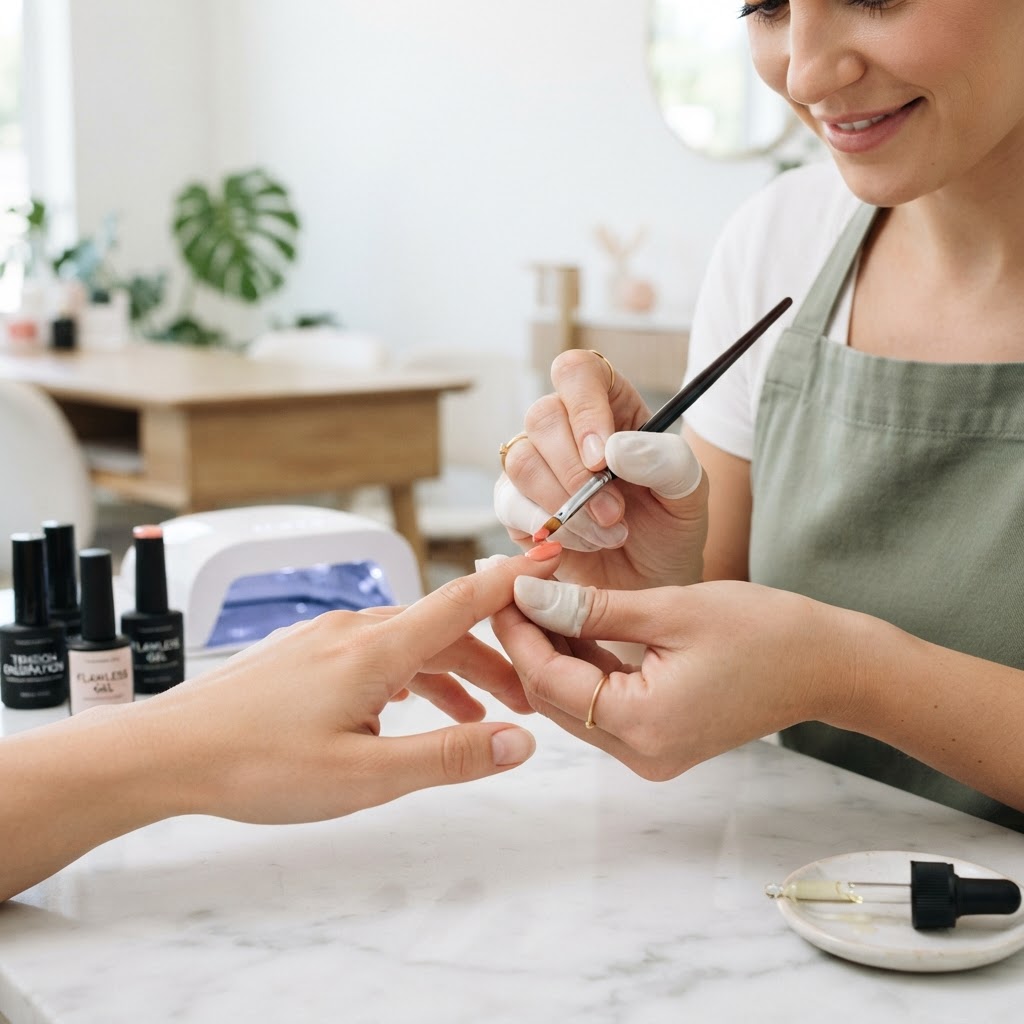
Understanding Surface Tension in Gel Applications
Many nail technicians struggle with color application issues—streaking, uneven pigment distribution, and the dreaded 'pull-back' at the cuticle—without realizing these are often physics problems rather than product quality issues. Surface tension is the elastic tendency of a liquid to acquire the least surface area possible. When applied to nail plates, this force can either work for you to create a self-leveling, mirror-like finish, or against you, causing the gel to retract toward the center of the nail.
The Three Pillars of Tension Control
1. The 'Substrate-Roughness' Baseline
Before color application, the surface energy of the nail plate must be uniform. If your base coat or structure gel is left too 'shiny' or smooth, the color gel has nothing to 'grab' onto, causing the pigment to beads up. Ensure your base layer is properly buffed with a 240-grit buffer to create microscopic surface area increases. This provides the necessary mechanical anchor for the color gel's molecules to distribute evenly rather than clumping.
Join the newsletter
Get fresh nail tutorials, trends, and business tips straight to your inbox.
2. The 'Thermal-Activation' Technique
Gel viscosity changes with temperature. If your gel is stored in a cold studio, it will naturally have higher surface tension, making it resistant to leveling. Before applying color, ensure your bottles are kept at a consistent room temperature. If you are working with a highly pigmented or thick viscosity gel, a quick roll of the bottle between your palms can lower the surface tension just enough to allow for smoother flow without creating air bubbles through vigorous shaking.
3. The 'Brush-Angle' Geometry
The most common cause of 'pooling' at the cuticle is not the amount of product, but the angle of the brush. When you approach the proximal fold, the bristles should be laid almost parallel to the nail surface. If the brush tip is pointed down toward the cuticle at a sharp angle, the bristles act as a 'wedge,' pushing the gel upward rather than gliding it across the plate. By utilizing a 'floating' technique—where the brush bristles are fanned out and never actually touch the nail plate—you allow the surface tension of the gel to level itself out against the previous layer.
Troubleshooting Common Failures
* The 'Center-Pull' Phenomenon: If your gel keeps pulling away from the sidewalls, your base layer may be contaminated with oils or debris. Use a lint-free wipe saturated in 99% IPA to 'de-grease' the inhibition layer of your base coat before applying color.
* Streaking in Pastels: Pastels have a high concentration of white pigment (Titanium Dioxide), which increases viscosity. Apply these in three ultra-thin coats rather than two thicker ones. This allows the surface tension to reset at each stage of curing, resulting in a streak-free opacity.
* Curing Ripples: If you notice small ripples after curing, your application was likely too heavy on one side. Always finish your application by 'capping the free edge' first, then running a clean, dry brush down the center of the nail to redistribute the bulk of the product before it enters the lamp.
Strategic Execution for Efficiency
To maximize your service time, practice the 'One-Hand Rotation.' Apply color to four fingers (excluding the thumb) and use a thin liner brush to perfect the cuticle line on all four at once. This allows the gel to self-level for 30-60 seconds before you flash-cure. By allowing the physics of self-leveling to do the heavy lifting, you reduce the need for aggressive filing, keeping the structural integrity of the manicure intact while achieving a professional, salon-grade finish.
Join the newsletter
Get fresh nail tutorials, trends, and business tips straight to your inbox.