
The 'Service-Tiering' Architecture: Engineering Profitable Service Menus for Salon Scalability
Move beyond flat-rate pricing by implementing a structured service-tiering system that protects your margins, manages artist capacity, and drives intentional client upsells.
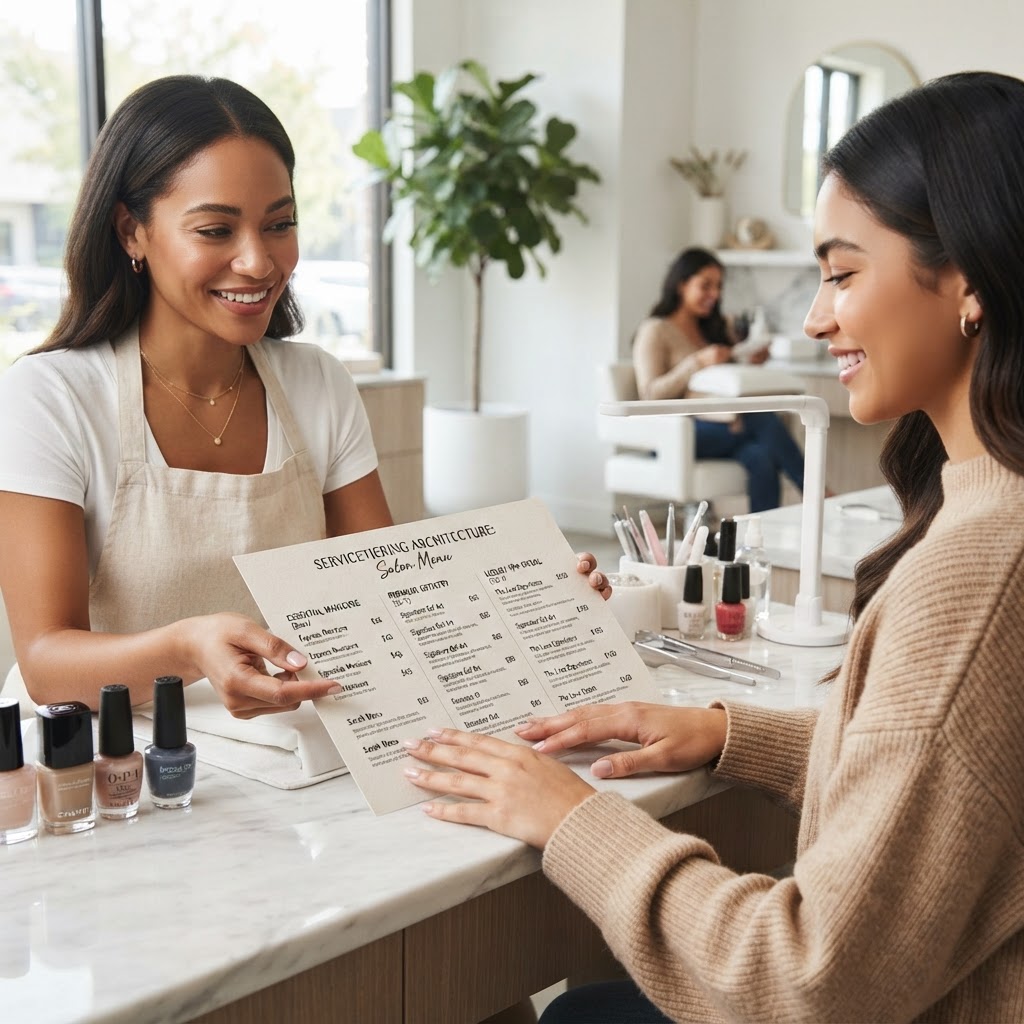
The Problem with Flat-Rate Service Menus
Most salons fall into the trap of 'menu sprawl,' where every request—from a basic gel manicure to a complex encapsulation—is lumped into broad categories. This creates a hidden profitability gap: your most talented artists are often under-priced for complex technical work, while your junior artists may be over-priced for beginner-level services, leading to inefficient scheduling and burnout.
The Tiering Framework
To scale, you must transition from a time-based menu to a complexity-based architecture. Categorize your services into three distinct buckets:
* Foundation (Level 1): High-volume, repeatable services. These are your 'bread and butter' offerings that provide consistent cash flow. They should be priced for efficiency, not for creative exploration.
* Technical (Level 2): Services requiring specific certifications or advanced skill sets, such as intricate sculpting, dry-manicure prep, or specific hardware proficiency. These carry a premium margin due to the specialized nature of the work.
* Artistic (Level 3): High-margin, low-volume 'signature' services. These are the showstoppers that build your brand. These should not be priced by the hour alone; they should be priced by the 'design complexity factor.'
Implementation Steps
Join the newsletter
Get fresh nail tutorials, trends, and business tips straight to your inbox.
1. Cost-of-Goods (COG) Auditing per Tier
For each tier, calculate the specific product usage. A foundation service shouldn't use the same high-cost sculpting gels as an artistic encapsulation. By isolating these COGs, you can set a 'floor price' for every service that ensures your material overhead never exceeds 10-12% of the total service cost.
2. Time-Boxing and Buffer Management
Create a standardized 'Time-Budget' for each tier.
By assigning a strict time budget, you prevent 'scope creep' where a client asks for additional art that pushes your day behind schedule. If they want more complexity, they must move up a tier.
3. The 'Upsell' Bridge
Train your staff to identify the bridge between tiers. If a client is booked for a Level 1 service but asks for an intricate accent nail, they are essentially 'upgrading' to a Level 2 service. Create an automated 'add-on' menu that corresponds directly to the complexity level of the base service.
Managing the Psychological Shift
Transitioning to a tiered menu can be daunting for loyal clients. Frame the change as a shift toward 'Customization and Quality.' When clients understand that they are paying for specific levels of technical expertise and material usage, they are less likely to view price increases as arbitrary.
Performance Tracking
Use your salon management suite to track the 'Capture Rate' of each tier. If you find that 80% of your bookings are in Level 1, you aren't scaling your brand; you are merely running a volume shop. If your Level 3 tier has low adoption, it’s time to re-evaluate your marketing and showcase your best technical work to draw in a higher-value clientele. By systematizing your tiers, you create a path for clients to grow with you, ultimately increasing the Lifetime Value (LTV) of every individual sitting in your chair.
Join the newsletter
Get fresh nail tutorials, trends, and business tips straight to your inbox.