
The 'Peripheral-Seal' Protocol: Mitigating Lateral Lifting Through Convex-Arch Filleting
Learn how to master the 'fillet' technique—a precision application method designed to eliminate lateral gel pooling and premature lifting in wide nail-bed architectures.
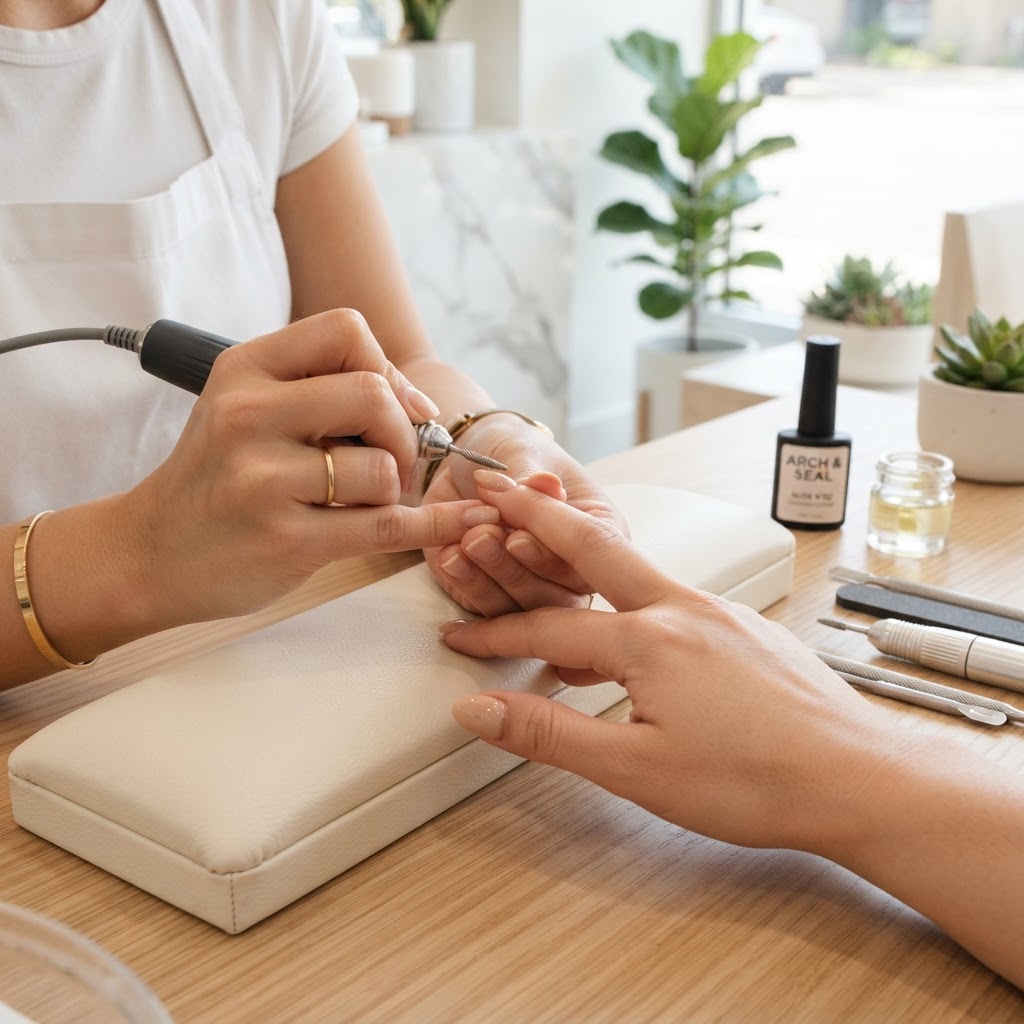
The Problem with Lateral Pooling
For many technicians, lateral lifting is not a product failure, but a failure of geometric intent. When working on wide, arched nail beds, the natural inclination is to apply gel flush against the side walls. However, the surface tension of high-viscosity builders often pulls the product away from the side walls during the curing process, or worse, allows it to overflow into the lateral grooves, creating a 'dam' that inevitably separates as the nail grows out.
Understanding the Convex-Arch Fillet
In mechanical engineering, a 'fillet' is a rounded corner between two surfaces. In nail architecture, we can apply this principle to the 'peripheral seal.' Instead of attempting a sharp, vertical drop-off at the edge of the nail plate, we must create a gradual, convex transition that mimics the natural slope of the proximal and lateral folds. This removes the 'gutter' where moisture and debris collect, effectively locking the gel to the nail plate.
The Three-Step Filleting Protocol
Join the newsletter
Get fresh nail tutorials, trends, and business tips straight to your inbox.
Why This Increases Retention
Lifting at the sidewalls is almost always caused by 'micro-contractions.' As builder gel cures, it undergoes a polymerization process that pulls the molecules inward. If your gel is too thin at the edges or if it has flooded the sidewall, that contraction force is strong enough to break the adhesion bond. By creating a thicker, convex fillet, you are providing a structural buffer that absorbs the energy of the contraction, keeping the perimeter of the enhancement firmly anchored to the substrate.
Practical Application Checklist
* Analyze the Sidewall Depth: If the lateral groove is deep, prioritize a thinner viscosity base gel that can flow into the crevice without 'pooling.'
* Control the Polymerization: Ensure your lamp has a 5-second 'flash cure' setting. This allows you to lock the fillet in place before the gel has a chance to migrate into the lateral folds.
* Post-Cure Refinement: After the full cure, take a light hand file to the very edge of the sidewall. If you feel a 'shelf' where the gel meets the natural nail, you have not achieved a true fillet. File until the transition is invisible to the touch.
By treating the lateral edge as a structural component rather than a boundary, you move away from the 'paint-by-numbers' approach and into true architectural mastery. This technique not only improves retention but elevates the aesthetic finish, giving your clients a seamless, natural growth transition that lasts until their next fill.
Join the newsletter
Get fresh nail tutorials, trends, and business tips straight to your inbox.