
The 'Peripheral-Seal' Gradient: Engineering Waterproofing for Long-Wear Gel Enhancements
Learn the precise micro-filing and polymerization techniques required to create a hermetic seal at the proximal fold, drastically reducing lateral lifting and moisture ingress.
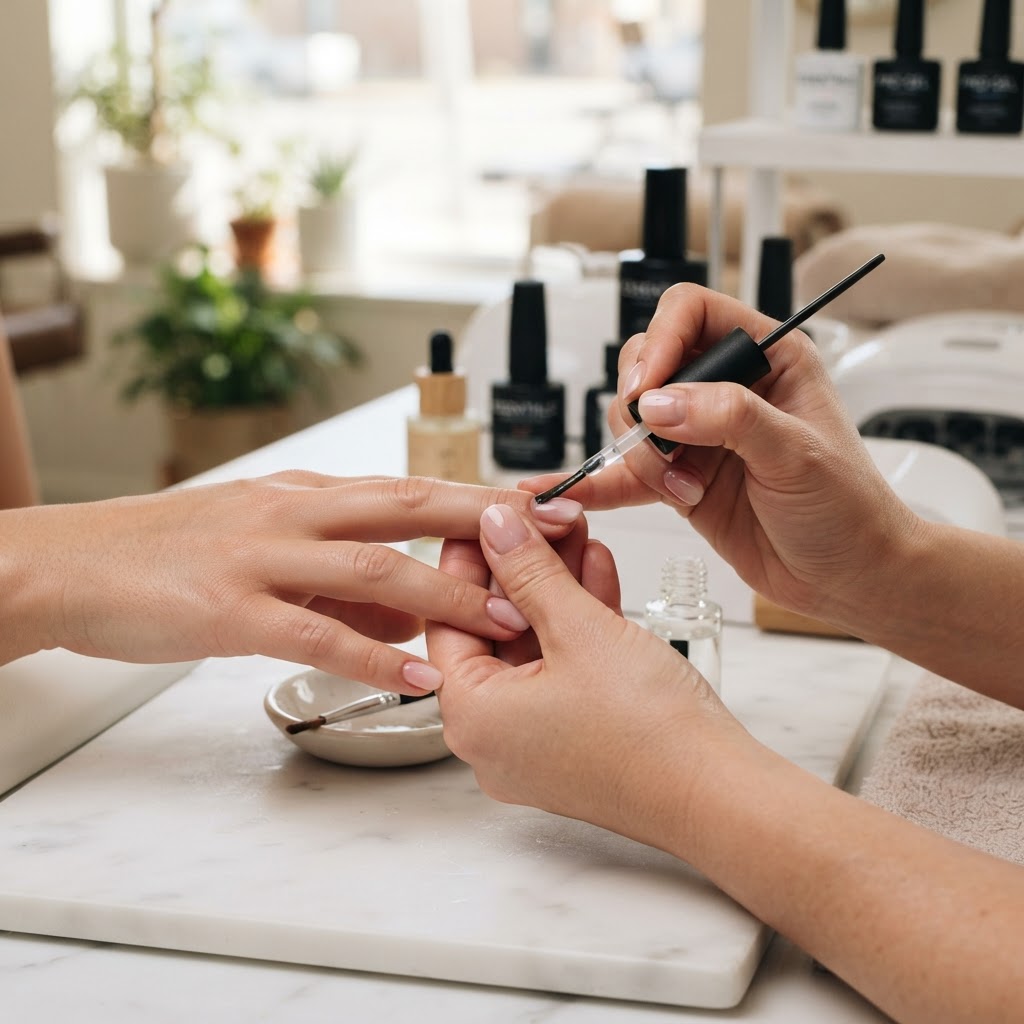
The Engineering of Longevity
For the high-volume nail technician, the most common point of failure in a gel enhancement is not the free edge, but the peripheral boundary. Moisture ingress at the proximal fold and lateral walls is the primary culprit behind premature lifting. The 'Peripheral-Seal' Gradient is a technical protocol designed to create a molecular-level bond that resists osmotic pressure, effectively 'waterproofing' your enhancements for a three-to-four-week wear cycle.
Phase 1: The Zero-Micron Prep
Before applying product, you must achieve a 'zero-micron' surface transition. Most technicians focus on cuticle removal, but the real issue is the invisible shelf of non-living tissue (the proximal nail fold debris) that prevents a flush seal.
* The Dry-Abrasion Step: Utilize a diamond-bit flame or ball bit at a low RPM (below 8,000) to exfoliate the nail plate specifically at the proximal fold. You aren't just removing cuticle; you are increasing surface porosity at the exact site where lifting begins.
* Dehydration Mapping: Use a lint-free wipe saturated in 99% isopropyl alcohol to scrub the lateral sidewalls in a circular, rather than linear, motion to clear out sebum that accumulates in the side-wall grooves.
Phase 2: The 'Thin-Film' Anchor
Join the newsletter
Get fresh nail tutorials, trends, and business tips straight to your inbox.
Many technicians apply too much base product, causing 'pooling' that shrinks during polymerization. To mitigate this, utilize the 'Thin-Film' Anchor technique:
Phase 3: The Gradient Polymerization
This is the core of the technique. Instead of a uniform thickness, you must engineer a gradient of density. The product should be thinnest at the proximal fold (the 'Seal') and build thickness only toward the apex.
* The Micro-Floating Technique: As you bring your builder gel toward the proximal fold, use the side of your brush to 'float' the product until it is nearly translucent.
* The 'Back-Step' Filers Edge: After the full cure, take a 180-grit file and 'back-step' the product at the cuticle line. This eliminates the 'step' (the ridge) between the natural nail and the product, making it physically impossible for the hair or skin to snag the edge of the enhancement.
Troubleshooting Lateral Ingress
If you find your clients consistently experience lifting at the lateral walls, you are likely suffering from 'Collateral Stress.' This occurs when the product thickness is uneven at the sides, causing the gel to pull away from the nail as it polymerizes. Always ensure your lateral walls are filed flush to the natural nail plane before applying your top coat. A thick, blunt side-wall is a magnet for accidental impact and lifting.
By systematizing this peripheral approach, you shift your work from 'cosmetic application' to 'structural engineering,' ensuring that the integrity of the seal is prioritized over the speed of the application.
Join the newsletter
Get fresh nail tutorials, trends, and business tips straight to your inbox.
