
The 'Morphological-Contour' Assessment: Calculating Lateral-Wall Parallelism for Structural Integrity
Master the geometry of the lateral sidewall to prevent structural stress and premature lifting in high-curvature nail plates.
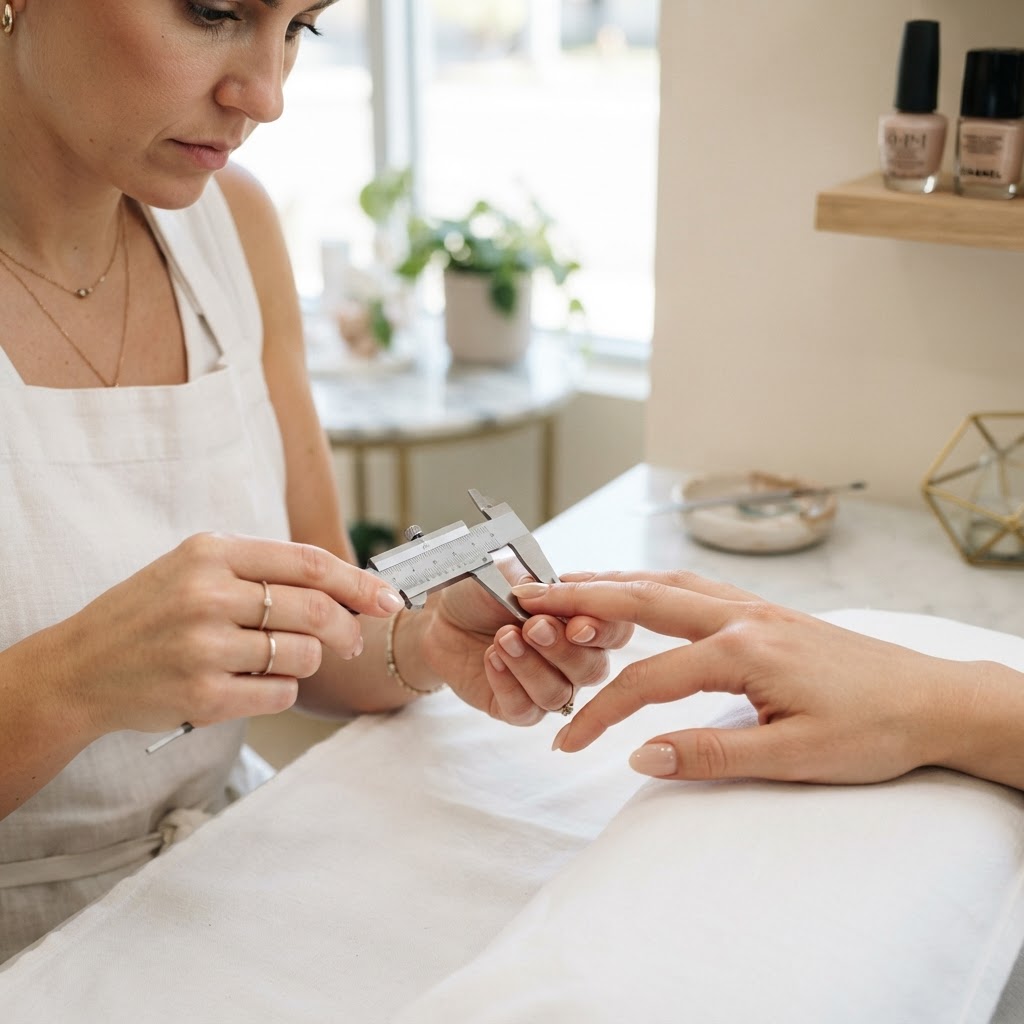
The Geometry of the Lateral Sidewall
In high-end nail artistry, structural longevity is rarely about the product itself, but rather the geometric alignment of the nail plate. When working with clients who possess hyper-curved or 'ski-jump' nails, the most common point of failure is not the free edge, but the lateral sidewalls. The 'Morphological-Contour' Assessment is a systematic approach to identifying the structural breaking point of a natural nail before the first layer of product is applied.
The Importance of Parallelism
True parallelism—where the sides of the nail appear as perfectly straight, non-converging lines from the proximal fold to the free edge—is the cornerstone of structural durability. When a nail is over-filed at the lateral walls, you lose the 'c-curve' tension, which is the primary architectural support for the nail bed. Without this tension, the nail plate is prone to lateral splitting and product lifting because the synthetic enhancement cannot grip the missing anatomical anchor points.
Performing the Morphological-Contour Assessment
Join the newsletter
Get fresh nail tutorials, trends, and business tips straight to your inbox.
Before you pick up your e-file, follow this three-step protocol to map the client’s unique morphology:
Troubleshooting Lateral Lifting
If you consistently see lifting at the lateral walls, it is likely due to 'over-filing of the transition zone.' The transition zone is the millimeter where the hard product meets the soft tissue. If you file this too thin, the product loses its ability to flex with the natural nail.
* Solution 1: Buffer-Only Refinement. Switch to a 240-grit buffer for the final refinement of the sidewalls. This prevents the unintentional gouging that often occurs with carbide bits.
* Solution 2: The 'Floating' Application. When applying your build layer, 'float' the product near the lateral walls. By keeping the brush parallel to the nail plate, you allow the self-leveling properties of the gel to create a smooth slope rather than a sharp cliff, which is the primary culprit behind stress-induced fractures.
Integrating the Assessment into Your Workflow
Integrating this audit into your service flow adds only 90 seconds to your prep stage but can increase the structural longevity of a manicure by up to two weeks. By assessing the contour before you shape, you transition from 'working on' the nail to 'engineering' a base that supports the client's specific lifestyle and biomechanics. Remember: your goal is to reinforce the natural architecture of the nail, not to reshape it into a structure it cannot sustain.
Join the newsletter
Get fresh nail tutorials, trends, and business tips straight to your inbox.
