
The Hyponychium-Safe Extension: Advanced Structural Support for Deep-Bed Clients
Discover the technical protocol for safely extending nails on clients with significant hyponychium growth, prioritizing structural integrity without sacrificing comfort.
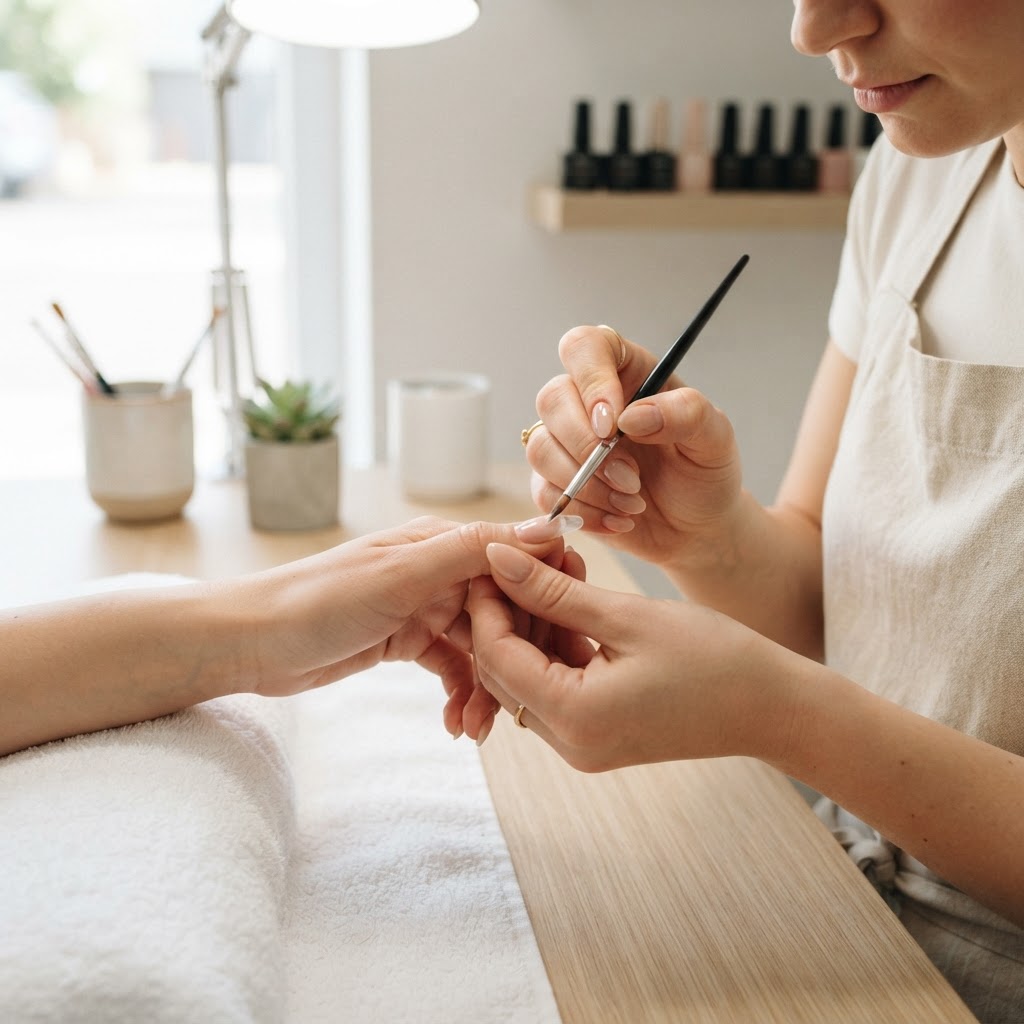
The Challenge of the 'High-Hyponychium' Client
Every nail tech encounters clients with an extended hyponychium—the sensitive skin layer under the free edge. Traditional forms often force pressure against this tissue, causing pain, inflammation, and eventual onycholysis. Many technicians simply truncate the form or leave the extension weak, but you can achieve structural perfection by modifying your scaffolding.
Step 1: The 'Concave' Form Modification
Standard forms are designed with a neutral curve. For deep-bed clients, you must create a concave arch in the paper form. Before applying the form to the finger, use your precision scissors to cut a subtle 'V' or 'U' shape into the center of the form’s leading edge. This prevents the paper from digging into the hypersensitive tissue.
Step 2: The Vertical 'Anchor' Technique
Join the newsletter
Get fresh nail tutorials, trends, and business tips straight to your inbox.
Instead of horizontal form placement, which forces the nail plate upward, use a slightly downward angle (10-15 degrees) during the initial base application. By building a thinner layer of clear builder gel or acrylic to 'bridge' the gap between the natural free edge and the form, you create a structural anchor that doesn't rely on the hyponychium for support.
Step 3: Managing the Stress Zone
Because deep-bed clients often have less natural free-edge stability, the stress zone must be shifted slightly further back toward the apex.
* Reinforcement: Apply a secondary 'skeleton' layer of fiber-infused gel across the center of the nail.
* Thickness Control: Maintain a paper-thin transition at the cuticle and the free-edge exit point to ensure the nail doesn't feel 'bulky' while maintaining maximum resistance to lateral force.
The Aftercare Conversation
Educate your clients that a deep hyponychium is often a sign of 'nail-bed stretching.' Encourage the use of high-quality cuticle oil to keep the hyponychium supple, which can actually help it recede naturally over time, giving you more space for future extensions. If the client experiences 'throbbing' immediately after the cure, it is an indication of heat spikes in the thicker zones—ensure you use a low-heat mode on your lamp to prevent thermal shock to the sensitive bed.
By treating the hyponychium as a boundary for structural design rather than an obstacle, you shift from being a 'nail applicator' to an 'architectural nail specialist.' This precision work commands higher service fees and ensures long-term client retention by eliminating pain-points in your process.
Join the newsletter
Get fresh nail tutorials, trends, and business tips straight to your inbox.
