
The 'Hydration-Lock' Protocol: Managing Product Adhesion on Dehydrated Nail Plates
Learn how to diagnose nail plate dehydration and adjust your chemistry-based prep to eliminate lifting without compromising natural nail health.
The Challenge of the 'Brittle' Client
Every nail tech has faced the client whose product seems to pop off in pristine, clean chunks within a week. While we often blame the prep or the lamp, the culprit is frequently the chemistry of the natural nail plate itself. Specifically, clients with chronically dehydrated nail beds struggle to hold onto monomer-based or oligomer-based products because the nail plate lacks the structural 'give' required to bond with polymerized gel.
Identifying Dehydration vs. Oiliness
Before you reach for an extra-strength acid primer, you must correctly diagnose the nail type. An oily nail plate will show lifting at the free edge or cuticle as a result of hydrophobic residue. A dehydrated nail plate, conversely, shows 'micro-cracking' or flaking at the surface. If you see the nail plate layers beginning to peel (delaminate) at the free edge, you are working on a dehydrated canvas.
The 'Hydration-Lock' Prep Strategy
Join the newsletter
Get fresh nail tutorials, trends, and business tips straight to your inbox.
Conventional advice suggests excessive dehydration (pure acetone or strong dehydrators). However, for a dry nail, this creates a feedback loop: you dehydrate the nail to prep, the product pulls moisture from the nail plate to bond, and the nail becomes even more brittle, causing the bond to snap. Here is the optimized protocol:
Structural Adjustments for Dry Nails
Dry nails are often brittle nails. If you apply a rigid, hard gel overlay to a brittle, dry nail, the nail will flex under the rigid product, causing the product to shatter at the stress points.
* Use Flexible Polymers: Switch your base layer to a low-viscosity, rubberized builder gel. The extra polymer chains in these formulas allow for 10-15% more flexibility than traditional hard gels.
* Lower the Apex: A lower, wider apex distributes stress across the entire nail plate rather than focusing it at the center. This reduces the 'lever effect' that snaps product off of dry nails.
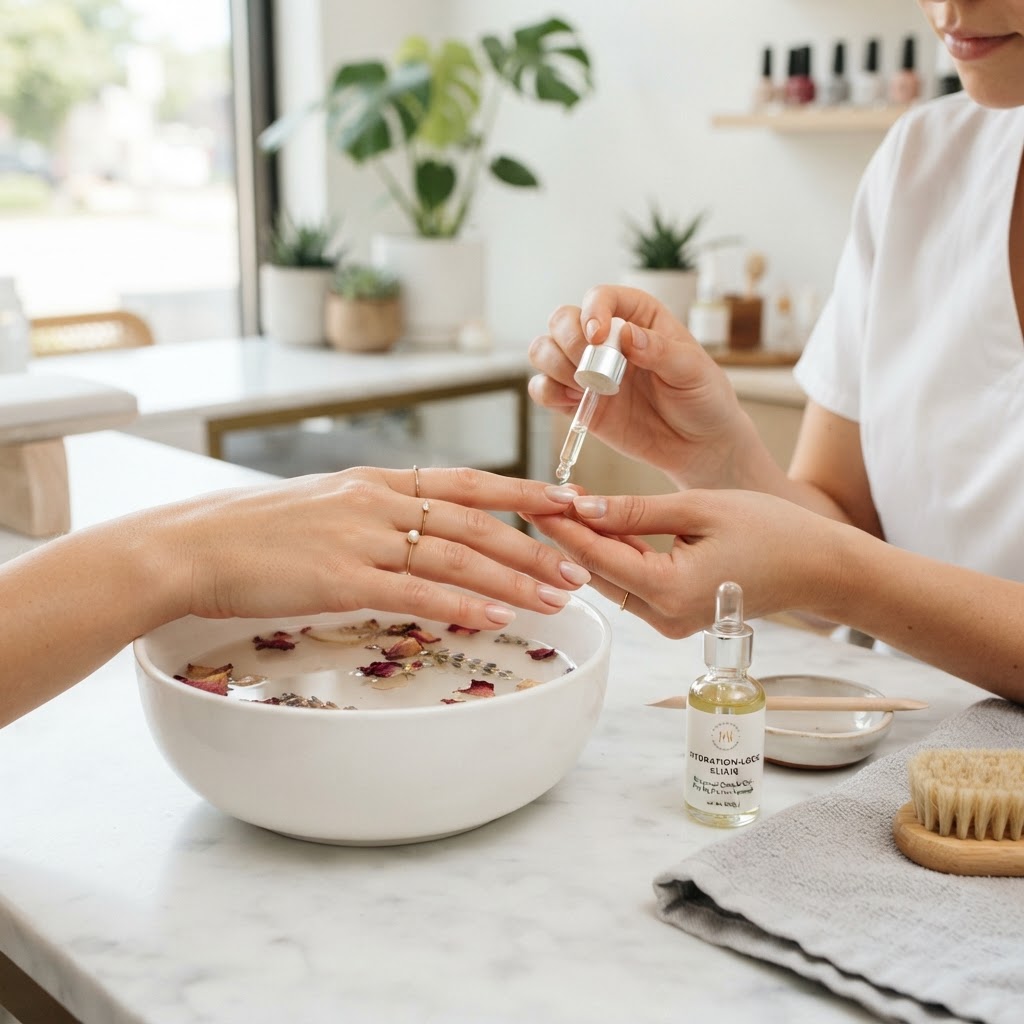
* Post-Service Rehydration: The most overlooked step is the post-service oil application. Encourage the client to use a jojoba-based cuticle oil three times daily. Jojoba oil has a molecular structure similar to human sebum and can actually penetrate the nail plate to restore its natural flex.
Long-Term Client Education
Explain to your client that their retention issues aren't a failure of your skill, but a mismatch between their nail chemistry and the product's rigidity. When you frame it as a 'custom structural solution' rather than a 'lifting problem,' you build trust and authority as a technical expert. If they refuse to use cuticle oil, they are opting out of the retention success you’ve carefully engineered.
Join the newsletter
Get fresh nail tutorials, trends, and business tips straight to your inbox.