
The 'Filament-Tracing' Mapping Method: Precise Line Work for Micro-Detail Nail Art
Master the art of steady-handed precision with the Filament-Tracing method, a structural approach to executing complex geometric and illustrative line work without hand fatigue.
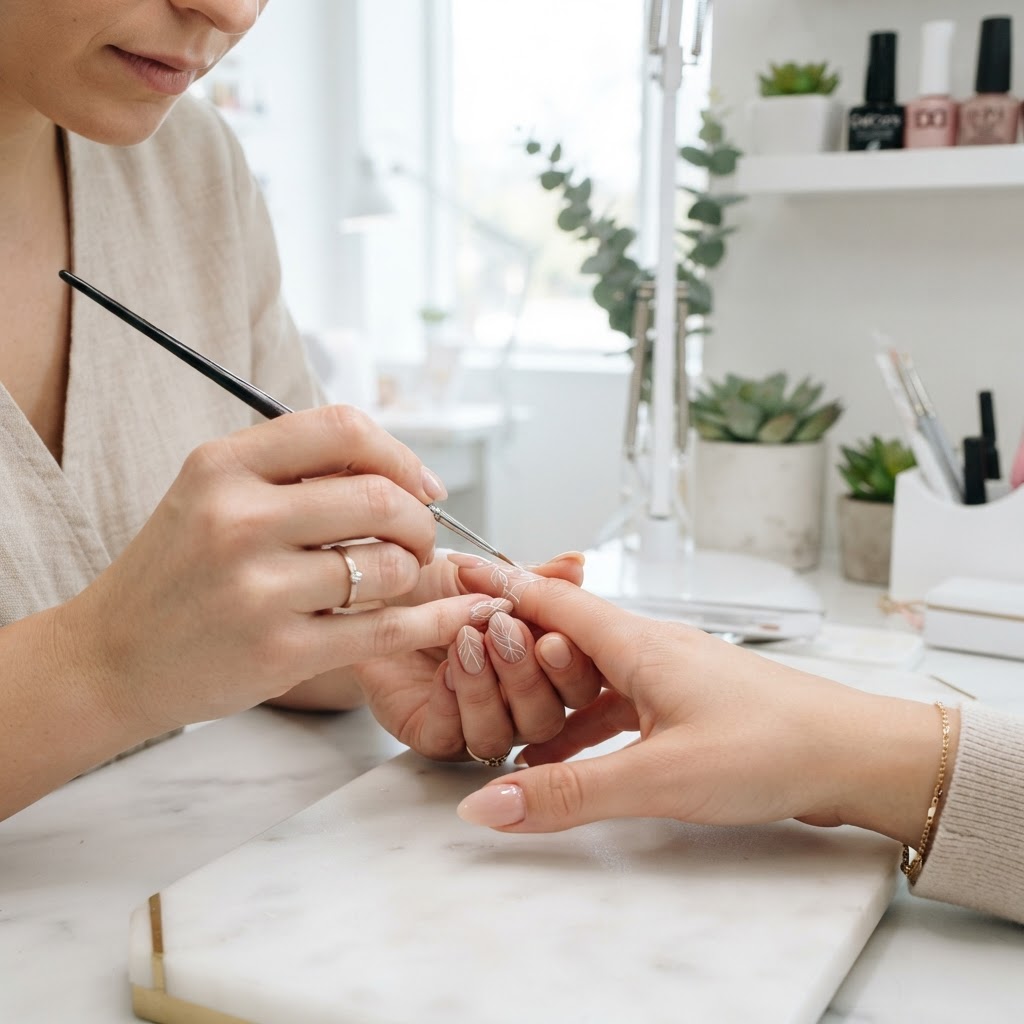
Mastering the 'Filament-Tracing' Mapping Method
For many nail artists, the transition from broad-stroke designs to micro-detail line work represents a significant plateau in skill development. Often, artists struggle with shaky lines, inconsistent pigment density, and the dreaded 'stutter' where the brush catches the uncured surface. The 'Filament-Tracing' method shifts the focus from drawing to engineering, treating your brush movement as a structural trace rather than a freehand sketch.
1. The Anatomy of the Filament Hold
Precision begins at the fulcrum. Most artists hold the liner brush with too much tension in the index finger, which creates a 'tremor-feedback loop.'
* The Three-Point Anchor: You must anchor your pinky finger on the client's hand (or the stand) and your ring finger against your own dominant hand. This creates a closed-circuit stability point.
* The Light-Touch Principle: Hold the brush as if it were a delicate eggshell. If your knuckles are white, you are applying too much pressure. The brush hairs should fan out only slightly; if they splay, your pressure is too heavy for the gel consistency.
2. The 'Bridge-and-Drag' Technique
Instead of attempting to draw a line in one fluid, high-speed motion—which often results in loss of control—use the 'Bridge-and-Drag' approach.
Join the newsletter
Get fresh nail tutorials, trends, and business tips straight to your inbox.
* Load the Filament: Ensure your liner brush is saturated but not dripping. The pigment should be suspended in the belly of the brush, not just at the tip.
* The Contact Point: Touch the tip of the brush to the nail surface at the starting point of your line. Do not move yet. Allow the gel to 'blossom' slightly on the surface.
* The Short-Segment Trace: Move the brush in segments of 2-3mm. Stop, lift slightly, reset your fulcrum, and bridge the next segment. By breaking a long line into 2mm 'micro-traces,' you eliminate the cumulative error that causes lines to veer off-course.
3. Managing Viscosity for Line Integrity
Even the best technique fails if the medium is incorrect. For intricate line work, you need a high-pigment, low-viscosity gel.
* The Palette Triage: Never draw directly from the bottle. Use a metal palette to pull a small 'filament' of gel out, then work the brush into the gel to ensure the hairs are fully coated and flat.
* Surface Tension Adjustment: If your lines are pulling back or beading up, your base surface is likely too 'slick.' A light buffing with a 240-grit sponge buffer before starting the line work creates enough friction to anchor the gel without leaving visible scratches.
4. Correcting Stutter and Blur
If your lines look 'fuzzy' or blurred, you are likely working too slowly or your light-cure sensitivity is off.
* The Flash-Cure Interval: After completing a cluster of lines (e.g., a geometric star or a complex petal), flash-cure for 5 seconds. This locks the pigment in place so that an accidental brush bump won't ruin your progress.
* The Clean-Edge Reveal: Use a tiny, flat square brush dipped in 99% isopropyl alcohol to 'clean' the edges of your lines immediately after your final full cure. This sharpens the design, making lines look laser-cut.
Conclusion
Micro-detail work is less about 'natural talent' and more about the physical management of pressure and structural stability. By adopting the 'Filament-Tracing' mapping method, you replace anxiety-fueled freehand drawing with a repeatable, systematic process that ensures every line is intentional, sharp, and perfectly executed.
Join the newsletter
Get fresh nail tutorials, trends, and business tips straight to your inbox.
