
The 'Dermal-Calibration' Protocol: Optimizing E-File Prep for Thin-Skin Integrity
Move beyond generic cuticle care with a technical protocol designed to protect the proximal fold while achieving professional-grade product adhesion.
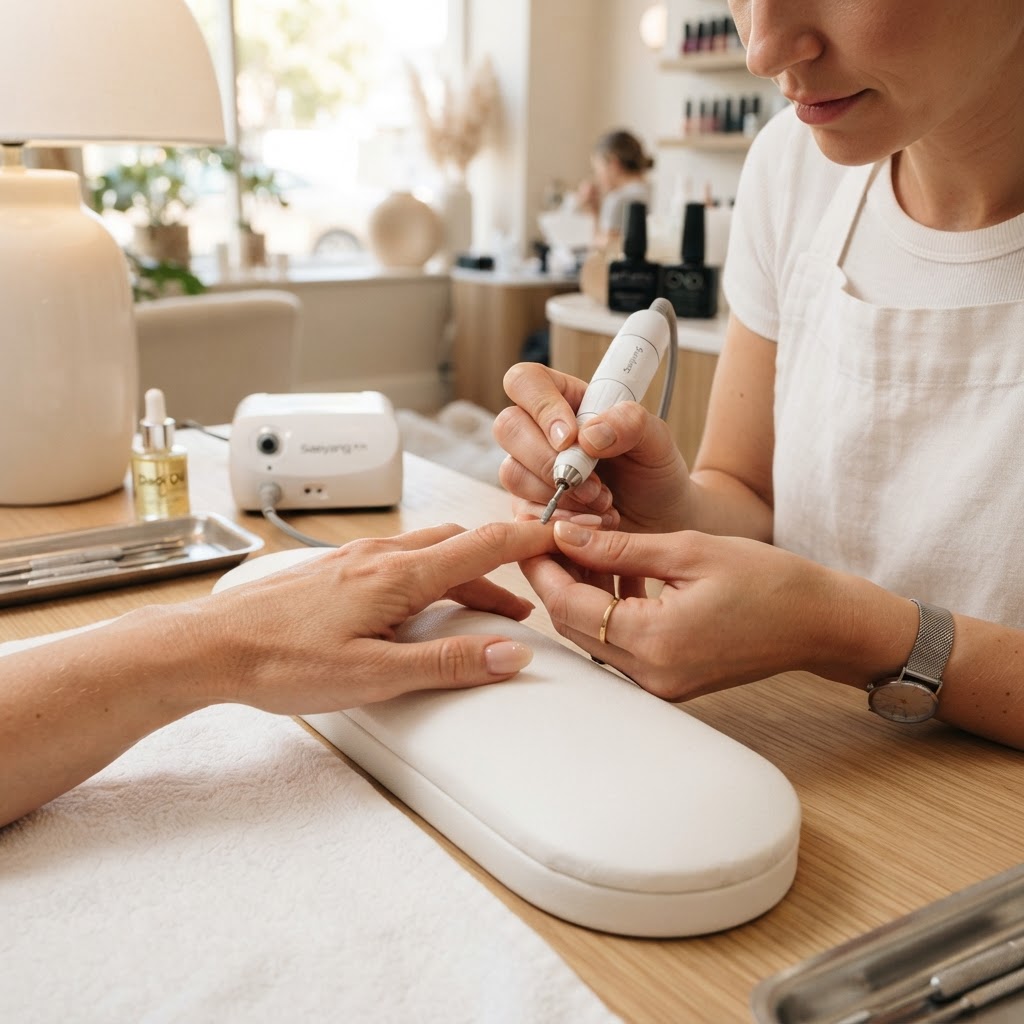
Understanding Dermal-Keratin Dynamics
For the modern nail tech, the battle for retention is often won or lost in the first fifteen minutes of the service. Many artists struggle with 'lateral lifting' or 'proximal edge separation,' mistakenly blaming their primer or their lamp. In reality, the culprit is often a misunderstanding of the proximal nail fold’s sensitivity. If your e-file pressure causes even micro-trauma to the dermal tissue, the body responds with a minor inflammatory process, releasing moisture and sebum that acts as a physical barrier against chemical adhesion.
The 'Dermal-Calibration' Protocol
To achieve a flawless, long-wear seal, you must transition from 'aggressive clearing' to 'controlled exfoliation.' This protocol focuses on the 'Zero-Contact' principle.
Phase 1: The Dehydrating Prep
Before touching a bit to the nail, perform a dry-rub cleanse with 99% IPA. This does not just clean the surface; it temporarily dehydrates the dead cuticle skin (the eponychium remnant), making it brittle and easier to remove without scraping live tissue.
Phase 2: Bit Selection and RPM Logic
Join the newsletter
Get fresh nail tutorials, trends, and business tips straight to your inbox.
For the proximal fold, swap your coarse carbide for a medium-grit diamond flame or a specialized 'safety' silicone carbide bit.
Phase 3: The 'Floating' Sweep
Instead of applying constant pressure, use a 'feathering' motion—flicking the bit away from the cuticle as you reach the apex of the fold. Imagine you are sweeping dust off a fragile surface rather than sanding wood. You want to lift the dead keratinized skin away from the nail plate, not grind it into nothingness.
Identifying the 'Red-Flag' Indicators
How do you know if you are over-processing? Watch for these three silent indicators during your e-file work:
The Adhesion Payoff
When you master the 'Dermal-Calibration' protocol, you create a pristine, dry canvas that hasn't been traumatized. Because the skin remains intact and un-inflamed, your base coat can form a molecular bond with the nail plate without competing against the body’s natural protective oils. This is the difference between a manicure that lasts two weeks and one that remains flush for four.
Join the newsletter
Get fresh nail tutorials, trends, and business tips straight to your inbox.
