
The 'Contact-Surface' Analysis: Optimizing E-File Bit Geometry for Cuticle-Zone Precision
Stop relying on feel and start relying on physics. Learn how to align your e-file bit geometry with the client's unique proximal fold morphology to prevent over-etching while achieving a flawless, high-definition finish.
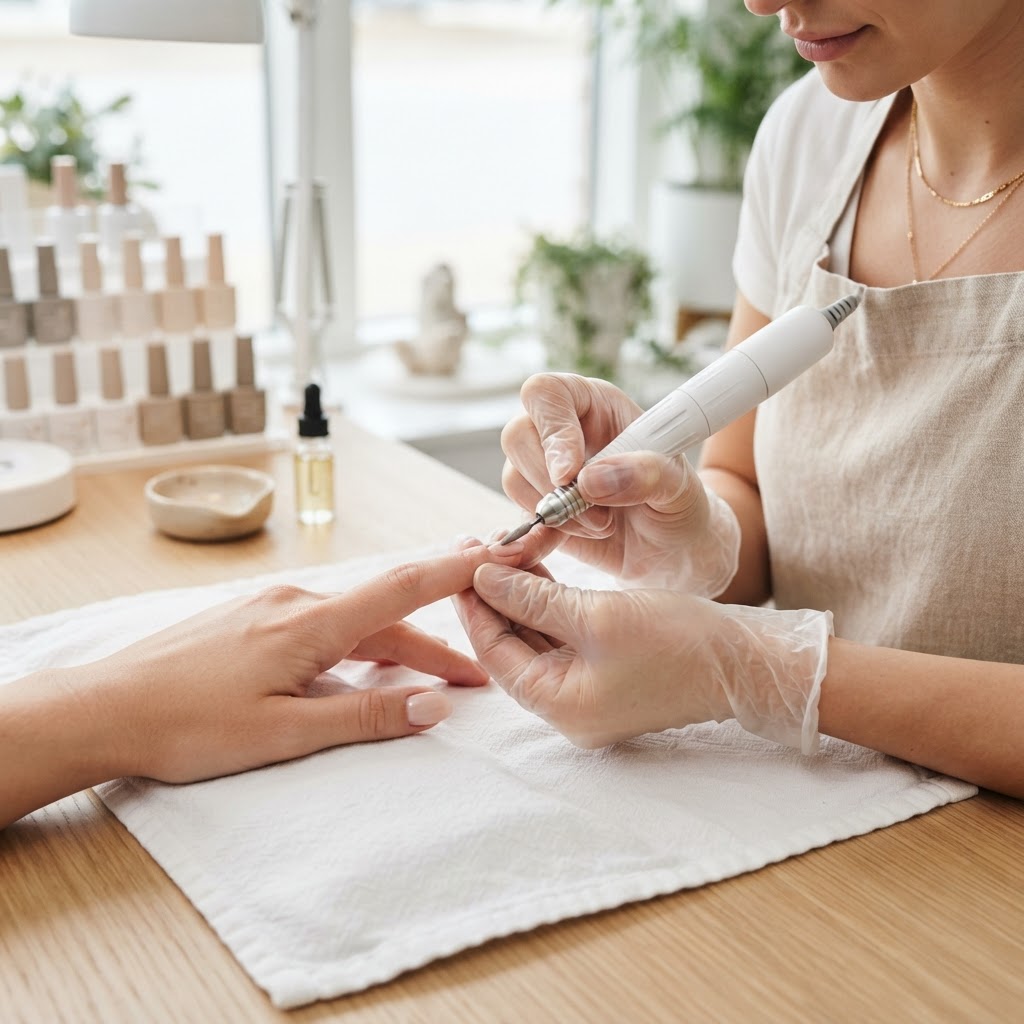
The Precision Challenge of Cuticle Refinement
For the professional nail technician, the cuticle zone is the ultimate 'make or break' area of a service. While many artists focus heavily on the artistic application of pigment, the structural integrity of your set often hinges on the initial canvas preparation. Over-refining leads to irritation and accelerated lifting, while under-refining leaves a 'shelf' that creates a premature growth gap. The key to consistency is shifting your perspective from general filing to 'Contact-Surface Analysis.'
Understanding Your Geometry
Every diamond bit or carbide barrel has a specific contact angle. When you hold your handpiece at a 90-degree angle to the nail plate, you are utilizing the maximum cutting surface of the bit. However, the proximal fold is rarely flat. To avoid trauma, you must calculate your bit’s 'Effective Engagement Area.'
* Flame Bits (Fine/Medium): Best used at a 15-to-25-degree angle. By engaging only the tip (the 'safe' zone), you avoid the danger of the belly of the bit catching the delicate skin of the eponychium.
* Ball Bits: These are designed for finishing, not deep exfoliation. Use these only once the nail plate has been cleared of the non-living tissue layer. Engagement should be light—think of it as 'polishing the skin' rather than 'cutting the nail.'
Join the newsletter
Get fresh nail tutorials, trends, and business tips straight to your inbox.
The 'Contact-Angle' Protocol
To master this, you must adopt a three-step movement pattern that prioritizes control over speed.
Mitigating Thermal Accumulation
High friction is the enemy of adhesion. When you linger too long on one spot during cuticle work, you build up thermal energy. This heat can cause the client’s skin to retract, making it look like you have created a clean line, only for the skin to swell back over the product once cooled.
To prevent this, implement the 'Pulse-Contact' method: touch the bit to the nail for no more than two seconds at a time, then lift. This short burst of activity effectively removes debris without compromising the integrity of the dermal barrier or causing micro-thermal damage to the nail plate.
Finalizing the Canvas
Once the cuticle area is refined, a quick pass with a high-grit buffer (240-grit or higher) is essential to remove any micro-scratches left by the e-file bit. This ensures that when you apply your base coat, the product can achieve a uniform molecular bond with the plate rather than pooling in the uneven 'grooves' created by an aggressive drill session. By standardizing your approach to bit geometry, you transform your service from a manual task into a repeatable, high-precision technical process.
Join the newsletter
Get fresh nail tutorials, trends, and business tips straight to your inbox.
